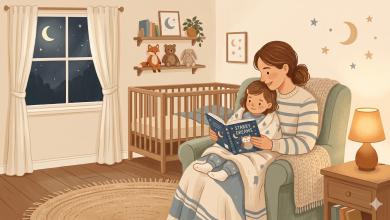
A peaceful evening doesn’t happen by accident – it’s built. And for children, especially those navigating long days filled with stimulation, expectations, and emotional ups and downs, a calming bedtime routine can be the difference between chaotic nights and restful ones. Over the past decade, sleep researchers, pediatricians, and child-development experts have consistently shown that predictable evening habits help children fall asleep faster, sleep longer, and feel more secure.
In this guide, we’ll explore how to build a truly calming bedtime routine – one grounded in real research, shaped by child psychology, and adaptable to different ages. All claims below reference real scientific literature and expert recommendations.
Why a Bedtime Routine Matters: What Science Tells Us
The idea of a bedtime routine is not merely a parenting trend – it’s a foundational principle in children’s sleep science.
The American Academy of Pediatrics (AAP) emphasizes that consistent pre-sleep habits help children regulate emotions and fall asleep more quickly, calling routines “a cornerstone of healthy sleep” (AAP, HealthyChildren.org).
A landmark study in Sleep Medicine Reviews analyzed bedtime routines across 45 scientific papers and found a strong relationship between consistent nightly habits and improved sleep duration, fewer nighttime awakenings, and better mood during the day (Sleep Med Rev., 2017).
Meanwhile, Harvard University’s Center on the Developing Child explains that predictable routines lower cortisol levels and stabilize a child’s stress-response system – critical for transitioning into sleep (Harvard CDC).
Or as pediatrician Dr. Harvey Karp succinctly puts it:
Kids relax when they can predict what comes next.
The Happiest Baby, https://happiestbaby.com
Step-by-Step: How to Build a Calming Bedtime Routine
Below is a practical, research-backed framework that works for toddlers, preschoolers, and school-age children. You can adapt timing and complexity depending on your child’s age and temperament.
Step 1: Set a Consistent Bedtime
Regular sleep timing is more important than most parents think. According to the National Sleep Foundation, consistency reinforces circadian rhythms and leads to better sleep quality (NSF).
A few guidelines:
- Choose a bedtime that allows the recommended sleep duration for your child’s age.
- Stick to the same sleep and wake times, even on weekends.
- Start winding down 30–60 minutes before the desired sleep time.
A stable schedule is the foundation everything else depends on.
Step 2: Create a Low-Stimulation Environment
Children cannot fall asleep in an environment that tells their brain it’s time to be awake.
What reduces overstimulation:
- dim, warm-toned lighting
- reduced background noise
- predictable, calm activities
- tidy, uncluttered space
- quiet tone of voice
What increases overstimulation:
- bright overhead lights
- loud play
- roughhousing
- sugar before bed
- emotional conversations
- screens (phones, tablets, TVs)
A Harvard Medical School study demonstrated that blue light from screens suppresses melatonin production and significantly delays sleep onset (Harvard Health Publishing, “Blue light has a dark side”).
For this reason, experts recommend eliminating screens at least one hour before bedtime.
Step 3: Add a Sequence of Predictable Rituals
A bedtime routine is not just a list — it’s a sequence. The predictability is what helps the nervous system settle.
A classic, research-backed structure looks like:
- Bath or warm wash-up – lowers body temperature afterward, which promotes sleep
- Pajamas – activates the brain’s “time for bed” association
- Quiet activity – puzzles, gentle play, talking about the day
- Brush teeth
- Reading together (most calming pre-sleep activity, per multiple studies)
- Goodnight ritual – hugs, songs, saying goodnight to objects, gratitude practice
The researchers Adams & Rickert (Pediatrics Journal, 1989) found that even a simple 3-step routine significantly improved sleep onset in young children.
Step 4: Make Reading the Centerpiece
Reading is the single most effective calming bedtime activity for children.
A 2021 article in the Journal of Sleep Research found that shared reading reduces stress, lowers heart rate, and speeds up sleep onset.
Beyond physiological effects, reading has emotional benefits:
- reinforces attachment
- provides closure to the day
- creates a safe emotional space
- reduces evening anxiety
Children’s author Mem Fox famously said:
When we read to a child, we are whispering love in their ears.
memfox.com
Choose slow-paced, gentle books – not exciting adventures right before sleep.
Step 5: Keep the Routine Short and Realistic
An effective bedtime routine does not need to be long. In fact, routines that are too elaborate can overstimulate or create dependence.
Research shows that 20–40 minutes is ideal for most families.
Signs the routine is too long:
- child becomes restless
- arguments begin
- parents lose patience
Signs the routine is too short:
- child is still keyed up
- child resists sleep
- multiple bedtime battles
Think of the routine as a rhythm, not a marathon.
Table: Recommended Bedtime Routine Structure by Age
| Age Group | Ideal Routine Length | Key Elements | Notes |
|---|---|---|---|
| 1–3 years | 20–30 minutes | Bath, pajamas, brushing teeth, 1–2 short books, comfort item | Keep steps simple and predictable |
| 3–5 years | 25–35 minutes | Bath/wash, pajamas, reading, short talk about the day | Avoid overstimulation from high-energy play |
| 6–9 years | 30–40 minutes | Hygienic steps, longer reading, journaling or gratitude | Allow child more autonomy |
| 10–12 years | 20–30 minutes | Reading, light stretching, quiet conversation | Avoid screens; encourage self-regulation |
Sources: AAP, NSF, Sleep Medicine Reviews (2017), Journal of Sleep Research (2021)
Step 6: Use Emotional Check-Ins to Reduce Bedtime Anxiety
Children often resist sleep not because they’re not tired – but because unresolved emotions linger from the day.
A simple emotional check-in can transform bedtime:
- “What was the best part of your day?”
- “Was there anything that made you sad or frustrated?”
- “What are you looking forward to tomorrow?”
This aligns with findings from the National Child Traumatic Stress Network, which highlights the importance of emotional regulation for sleep readiness (NCTSN).
Avoid pressure-heavy conversations; bedtime should not be for discipline.
Step 7: Add a Consistent “Final Cue” for Sleep
Children thrive when they know the routine is ending. Examples:
- “One last hug – sleep well, I love you.”
- A short lullaby
- Turning on white noise
- Saying goodnight to objects
The final cue should always be:
- short
- calm
- predictable
This helps children transition from shared activities to independent sleep.
Common Mistakes Parents Don’t Realize They’re Making
Even well-meaning habits can unintentionally disrupt bedtime.
Mistake 1: Too many choices
Choices lead to negotiation. Offer 2-3 controlled options.
Mistake 2: Inconsistent steps
Predictability is what calms the brain.
Mistake 3: Exciting books right before sleep
Save energetic stories for daytime reading.
Mistake 4: Emotional conversations at the wrong time
Talk earlier in the evening.
Mistake 5: Letting the routine get longer every night
This teaches the child to delay sleep.
Conclusion: A Routine That Helps the Whole Family
A calming bedtime routine is not just about getting children to sleep – it’s about emotional grounding, connection, and building long-term healthy habits. When routines are consistent, predictable, and soothing, children fall asleep more easily, sleep better, and wake up better regulated for the next day.
But remember: every child is unique. Consider these steps as evidence-based guidelines rather than strict rules, and always consult a pediatrician or sleep specialist if sleep concerns persist or worsen.
A peaceful bedtime is built one small, consistent ritual at a time – and the benefits last for years.